
CSOs Call for Stronger Community Leadership and Sustainable Financing to Advance Health Sovereignty in Africa
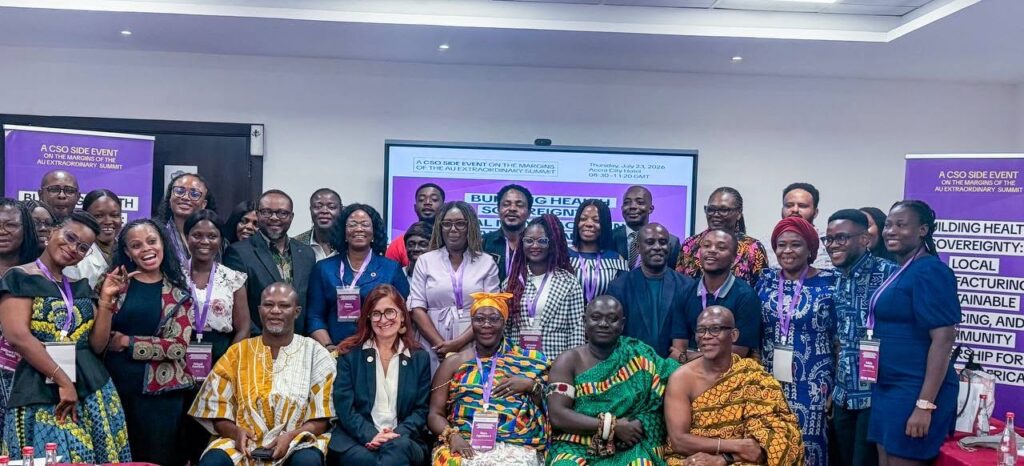
As part of activities on the margins of the African Union Extraordinary Summit, Hope for Future Generations (HFFG), in partnership with GFAN Africa, Impact Santé Afrique, WACI Health, the Ministry of Health and the Ghana Health Service, convened a high-level Civil Society Organization (CSO) side event under the theme: “Building Health Sovereignty: Local Manufacturing, Sustainable Financing and Community Leadership for Health in Africa.”
The dialogue brought together policymakers, researchers, development partners and civil society leaders to examine how Africa can build resilient health systems through local solutions, increased domestic investment and stronger community engagement.
Delivering remarks during the event, Josephine Saki, Board Member of HFFG and representative of Social Safe Ghana, underscored the indispensable role of civil society organizations in the fight against HIV and tuberculosis.
She noted that CSOs remain the voice of communities, connecting grassroots populations with policymakers while ensuring that vulnerable groups are not left behind.
According to her, CSOs have made significant contributions to HIV and TB prevention, community education, case finding, treatment support and linking affected persons to quality healthcare services.
Mrs. Saki explained that HFFG continues to strengthen collaboration among CSOs by creating platforms for dialogue, advocacy and collective action to ensure governments honour their commitments towards improving health outcomes.
She stressed that one of the key priorities is advocating for government to fulfil its co-financing obligations to the Global Fund, which remains critical to sustaining HIV, tuberculosis and malaria programmes across the country.
“Our voices become stronger when civil society speaks together. We must continue to hold duty bearers accountable while educating communities and ensuring no one is left behind,” she said.
Adding to the discussions, Professor Anita Gansa, Associate Professor and Head of Parasitology at the Noguchi Memorial Institute for Medical Research, highlighted the importance of health sovereignty through local research, innovation and manufacturing.
She explained that civil society serves as an important bridge between scientific research and communities, ensuring that research translates into improved health outcomes.
Professor Gansa observed that lessons from the COVID-19 pandemic demonstrated Africa’s dependence on external supplies for vaccines and medical commodities, emphasizing the need for countries to invest in local manufacturing and research capacity.
She further noted that producing medicines and vaccines locally must go beyond manufacturing to include innovation, scientific knowledge generation and understanding diseases unique to African populations.
The discussions reaffirmed that achieving health sovereignty requires sustained domestic financing, strengthened community leadership, accountable governance and strategic partnerships that place African solutions at the centre of Africa’s health future.
As HFFG celebrates 25 years of advancing health and development, the organisation remains committed to working with governments, civil society, researchers and development partners to build resilient health systems that leave no one behind.
